From Silence to Song: 37-Year-Old Joy Kimeu Survives a Massive Stroke and Gains the Ability to Sings Again
- Category: Blog
- Posted On:
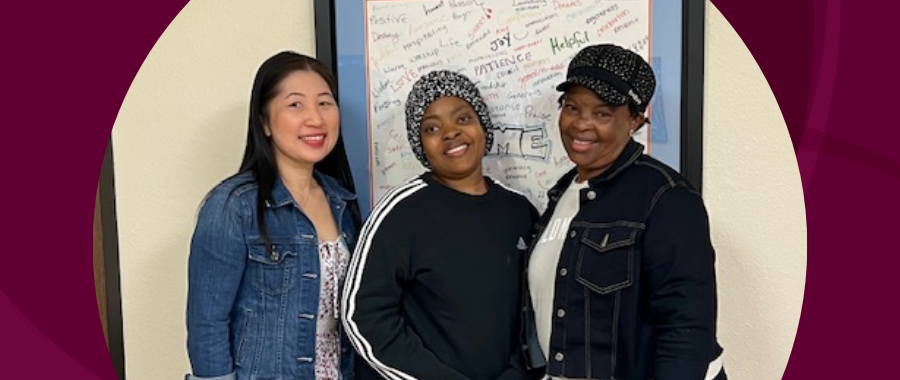
Doctors were worried when 37-year-old Joy Kimeu of Upland arrived at Pomona Valley Hospital Medical Center’s (PVHMC) Emergency Department (ED). Time is precious when treating a stroke like Joy’s, and they weren’t sure she would survive — let alone walk, talk or sing again.
It all started one morning this past July while Joy was getting ready to take her nursing school exams. Joy was nervous but also excited about the prospects of starting a new career soon.
“All of a sudden, I was numb and I dropped to the floor,” says Joy. “The last thing I remember was my mother calling 911.”
Joy suffered a massive stroke and was first taken to a local hospital, but her condition required her to be transferred to PVHMC’s Comprehensive Stroke Center for advanced care.
Vladimir Cortez, DO, neurosurgeon at PVHMC, successfully performed a thrombectomy, a procedure for stroke that removes a blood clot from a blocked vessel in the brain by using a special thin wire that is inserted in the groin and moves up to the brain to remove the clot. The procedure is performed at hospitals with a comprehensive stroke program that are qualified to perform this advanced procedure. The doctor and the surgical team at PVHMC were able to successfully clear the blocked artery in the left frontal lobe of her brain.
PVHMC’s Comprehensive Stroke Center is certified by the Joint Commission and recognized by the American Heart/Stroke Association for providing the highest level of care for stroke patients. The program addresses the rapid assessment, diagnosis and treatment of stroke patients admitted to the emergency department
“She was so young and critically ill,” recalls Dr. Cortez. “She was fortunate that when her stroke occurred, her mother was with her and was able to get her immediate care that ultimately saved her life.”
The underlying cause of Joy’s stroke was hyperthyroidism, a condition that can speed up the body's metabolism, which can cause symptoms such as weight loss, hand tremors, and a rapid or irregular heartbeat.
This condition resulted in atrial fibrillation, also known as AFib, which causes the heart to beat irregularly, whether too slow or too fast. AFib can increase the chance of blood clots and, according to the American Heart Association, accounts for about 15% of the 800,000 strokes that occur each year.
For weeks, Joy’s condition was critical and she was dependent on life support. Her care team at PVHMC met regularly with Joy’s mother to discuss a continuance of aggressive protocols or opt for comfort care. Joy’s mother wanted the aggressive protocols to continue.
Among Joy’s care team was Katey Vuong, BSN, RN, a palliative care nurse navigator, who became close with Joy’s mother as they worried together if Joy would survive.
“Every time I saw her mom, she would hug me, and we would pray together,” Vuong said. “She never stopped believing her daughter would wake up.”
Slowly, Joy began to recover, but it was hard-fought as she needed both a tracheostomy and a feeding tube to keep her alive. As each week passed, Joy became stronger and eventually was able to wean off life support.
Nearly seven weeks after being admitted to PVHMC, Joy began to speak again.
Months later, after Joy was discharged for rehabilitation, Vuong received a short video from Joy’s mother that brought tears to her eyes.
“In the video, Joy was home, walking, smiling, talking and even singing,” Vuong said.
Her favorite singing material is gospel, reggae and pop songs. While Joy is still undergoing rehabilitation for her right hand, she’s thriving and doing well. She’s grateful to the physicians, nurses and staff at PVHMC.
“I’m so happy to be alive and given a second chance,” says Joy. “If it wasn’t for the great team at the hospital, I wouldn’t be where I am today.”
Stroke is the leading cause of death and disability in the U.S. Understanding the signs of a stroke and receiving immediate care are crucial for survival and maintaining abilities.
Remember “BEFAST:”
B – Balance difficulty.
E – Eyesight /vision changes.
F – Facial drooping on one side.
A – Arm or leg numbness or weakness on one side.
S – Speech that is slurred, or difficulty understanding or speaking to others.
T – Time. Don’t wait to call 911.