Retired Employee’s Heart Leads Him Back to PVHMC for a Life-Saving Procedure
- Category: Blog, Heart And Vascular
- Posted On:
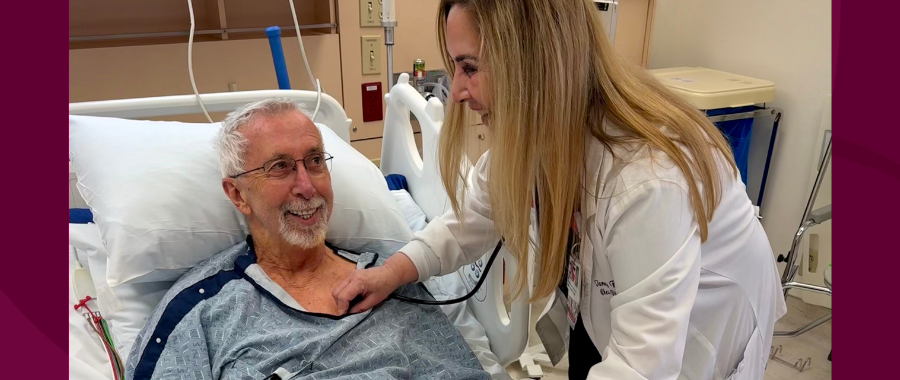
Retired Employee and Volunteer Gets New Heart Valve in Minimally Invasive TAVR Procedure
It seems like Jerry Choppi, 77-year-old Alta Loma resident, has a hard time leaving Pomona Valley Hospital Medical Center (PVHMC). After more than 38 years as an employee, Jerry retired from his last position as the director of the Respiratory, Non-Invasive Cardiology and Neurology Department more than a decade ago. About two years ago, he returned as a volunteer to shuttle patients around the hospital. In January of this year, he returned to the hospital once again, but this time as a cardiac patient.
“In high school, before I could try out for the football team, I had to pass a physical” says Jerry. “They found that I had a heart murmur then, but I still received clearance to play, and naturally as I aged my condition worsened.”
In January of this year Jerry returned to PVHMC’s Catheterization Lab for a Transcatheter Aortic Valve Replacement (TAVR) a minimally invasive procedure for severe aortic stenosis. Gaurav Parikh, MD, interventional cardiologist, performed Jerry’s procedure.
Aortic stenosis is a condition when the flaps (or leaflets) that make up the heart’s aortic valve become stiff with calcium buildup. The buildup affects the opening and closing of the heart valve and critical blood flow that brings oxygen to the body is reduced making sufferers often feel lightheaded or out of breath.
During the TAVR procedure, a new heart valve is inserted by way of a catheter in the groin area. The old heart valve remains in place after the procedure, fixed in such a way as to not interfere with the function of the new valve. Since the operation is minimally invasive, recovery is quicker, around two to three weeks, and the hospital stay is much shorter, around two days, when compared to open heart surgery.
According to the American College of Cardiology, since the approval of the first TAVR in 2011, over 276,000 patients have undergone the procedure. Access to the procedure has since been extended and the volume of patients getting a TAVR has increased every year since.
“The people were great in every single unit of the hospital and the care I received is amazing,” recalls Jerry. “I have nothing but praise for the staff, the nurses, Dr. Parikh, everybody.”
Today, Jerry goes to cardiac rehabilitation twice a week where he walks on the treadmill under the watchful eye of a specialized therapy team and goes to the YMCA three times a week for a weight workout and additional exercise.
Jerry’s procedure was performed at Stead Heart & Vascular Center at PVHMC, which is lauded for its comprehensive cardiovascular and stroke services in the region. The Joint Commission granted it’s Gold Seal of Approval™ recognizing the center as a Comprehensive Stroke Center, and the American College of Cardiology has named the facility a Designated Chest Pain Center.
“My condition has improved a lot thanks to the TAVR procedure,” adds Jerry. “I can’t stress enough how helpful the Pomona Valley Hospital Medical Center staff is and how well they took care of me.”
To learn more about cardiology services at the Stead Heart Vascular Center at PVHMC, visit: https://www.pvhmc.org/centers-of-excellence/stead-heart-vascular-center-old/.